Professional Projects
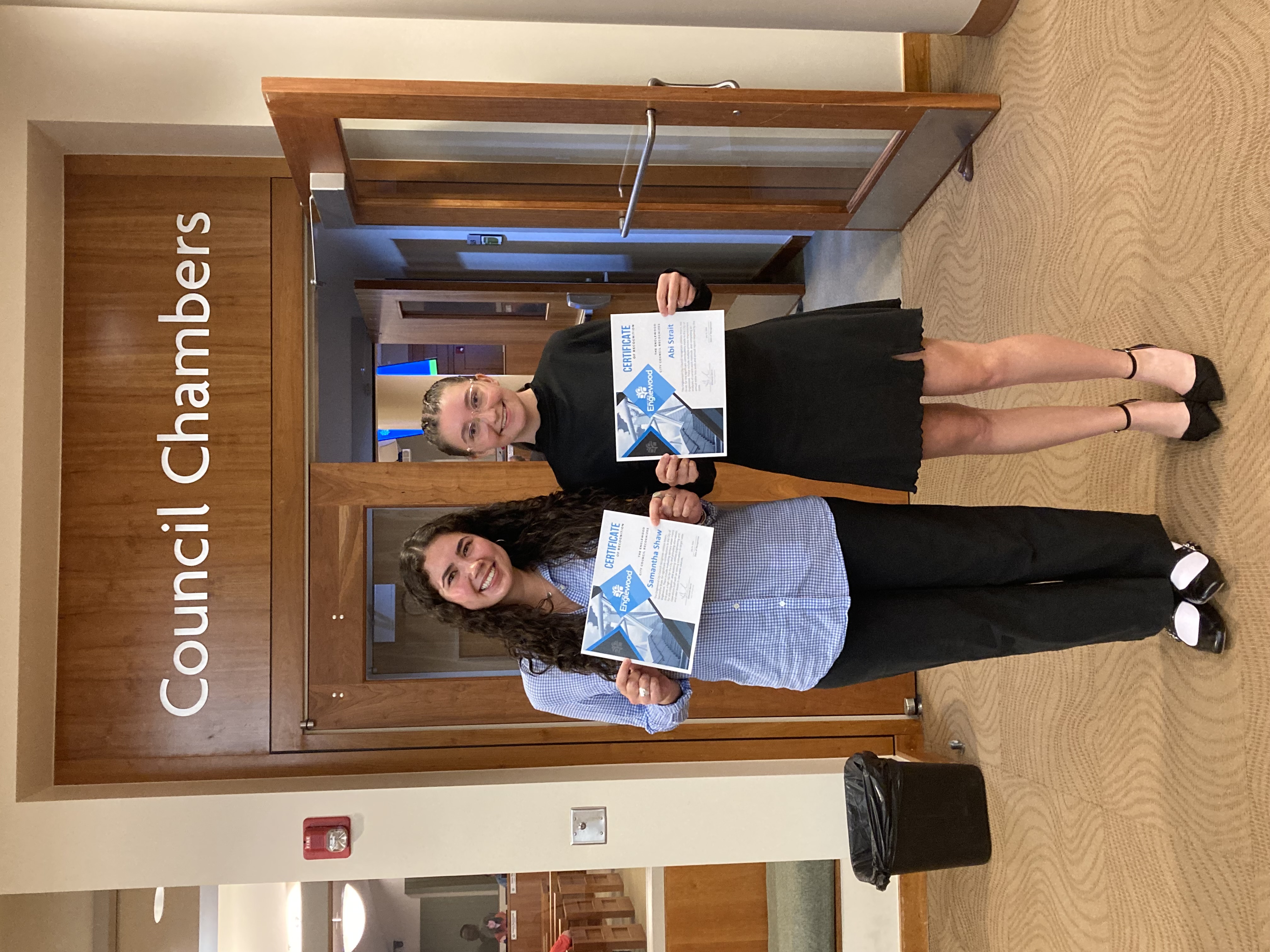
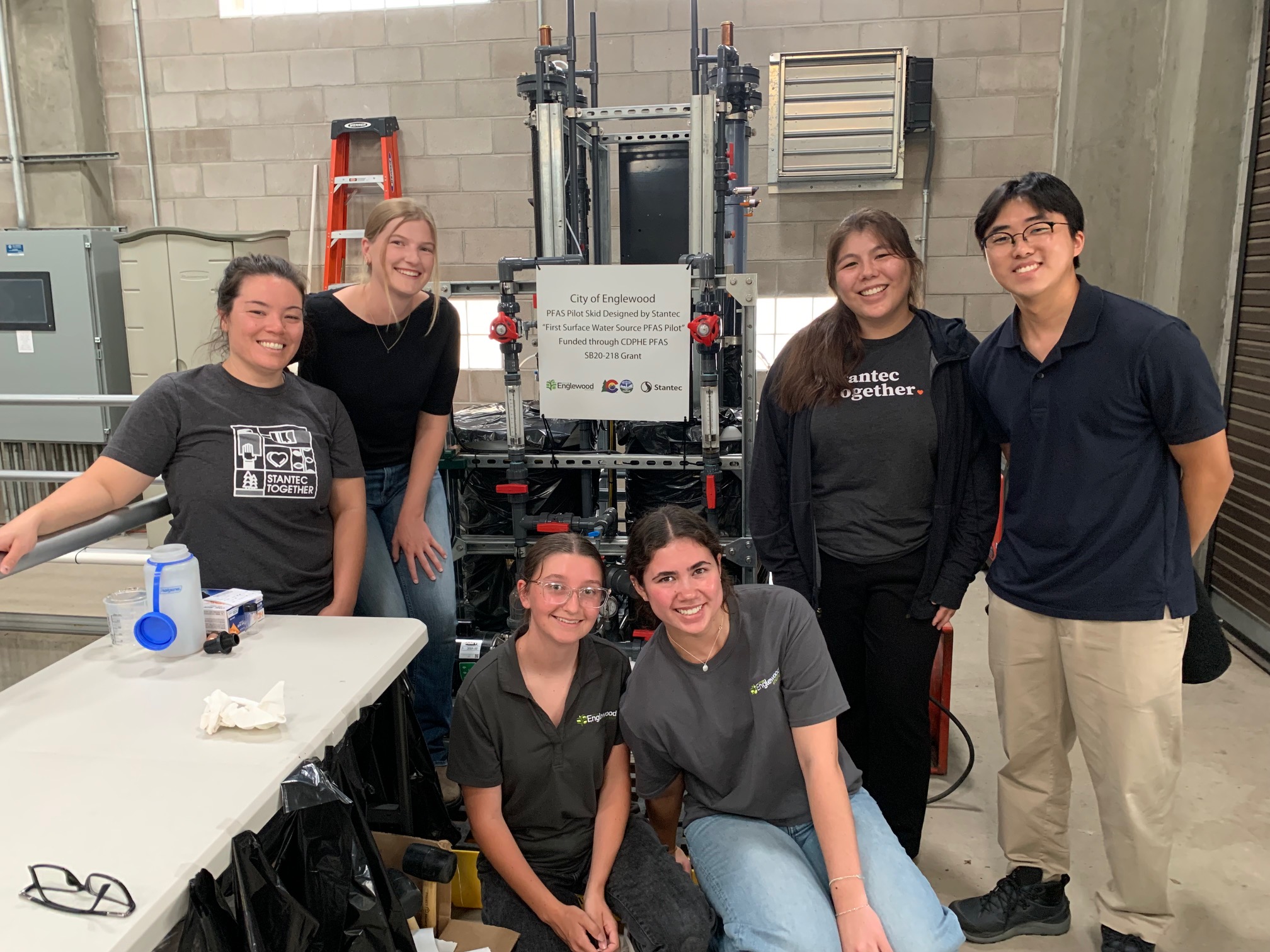
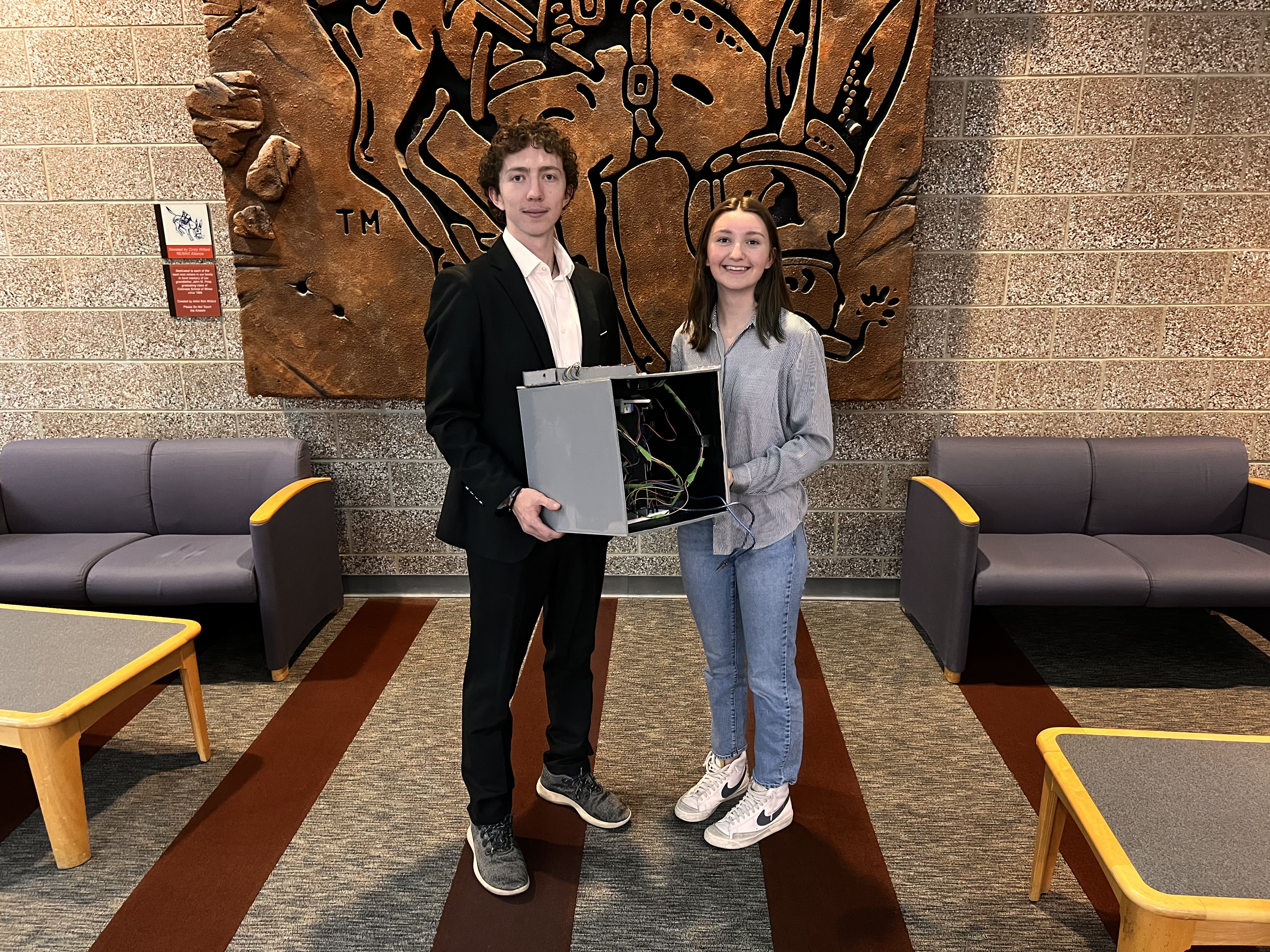
Image of me holding Englewood Utility certificate Image of me holding Englewood Utility certificate

Englewood Utilties Internship

Summer 2024

During my internship, I supported critical water and wastewater reliability work by collecting and validating dam height readings from piezometers in Excel to help monitor overflow risk for ~35,000 residents. I also analyzed ozone dosage data in Excel to optimize treatment performance—reducing manganese by 24.5%, TOC by 11%, and hardness by 7.2%—and completed a full audit of the 2023 water system in AWWA software to improve data accuracy by 2%, then authored a standard operating procedure that was adopted citywide. On the planning and process side, I used ArcGIS Pro to map seven high-risk sewer lines and model flow-related risks to support the 2025 Master Plan. I also built a Visio workflow of the development review process to identify bottlenecks and propose improvements, and I wrote a final memo evaluating Union Avenue Pump Station solids—presenting removal options with pros/cons and forward-looking recommendations for a board-level audience.
Personal Projects

Project E

I grew up tutoring students in the Title 1 (low income) schools that my mom taught for. I saw the disparity in education when parents can't speak english at home, the parents can't afford tutoring, and the students are not getting the support they need. In highschool I started tutoring for Mathnasium, and while Mathnasium is a great tutoring company, I thought about those Title 1 students who would not be able to afford tutoring companies such as Mathnasium. I want to help bridge the gap between and equal education and student's socioeconomic status. I've started what I hope will someday become a non-profit organization that will offer free tutoring services to students in need. In my first year of college I competed in the Mines Philanthropy Tank with Project E and won. The next step is to create a website for Project E that will connect students looking for volunteer hours to students in need. Since most of these students lack the technology that will be needed to access the website, they will be connected through the Title 1 schools.


abistrait.com

This personal project is the website you're currently viewing. It showcases my skills and projects in a clean, responsive design. It's built using HTML, CSS, and JavaScript, and is designed to be user-friendly and visually appealing. I learned these programming languages first from a YouTube channel called LearnCode.Academy. After testing different code and web styles I settled on a design I was satisfied with, then went back and reorganized and relinked the files for clearer documentation. To make the process even easier on myself, next time I create a website, I will map out each section to know how many divs and classes I need before starting. I'm proud of the work I've done on this project, and I hope you enjoy exploring it as much as I enjoyed creating it. Feel free to browse around and see what else I have to offer!

Academic Projects

Finite Element Analysis of an Automobile Suspension

Junior Year - MEGN 324

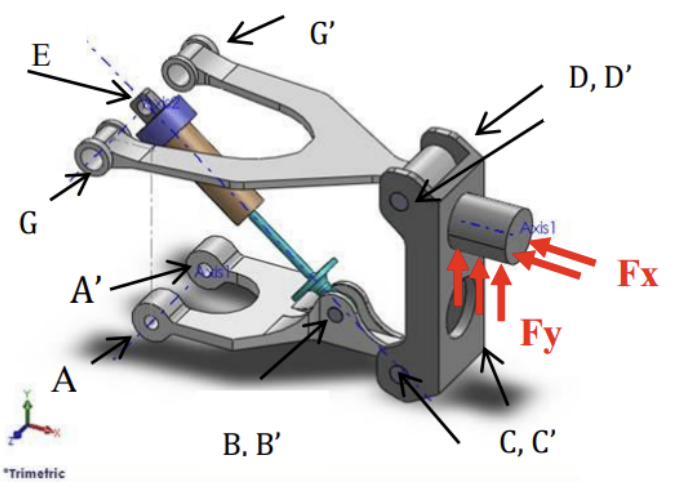
For my FEA project, I built and verified a finite-element model of a rear double-wishbone suspension corner with the main goal of reducing lower control arm mass while maintaining a minimum factor of safety of 3.5 under a combined wheel load case. I used SolidWorks Simulation to run two full-assembly studies (fixed-length shock vs. a 500 lbf/in spring-supported shock) and a higher-detail standalone lower control arm study, modeling joints with hinge fixtures and pin connectors and applying 100 lbf horizontal + 50 lbf vertical load at the knuckle spindle. I backed up the simulation with a mesh convergence study and hand-calculated statics / mechanics-of-materials checks to confirm reactions, stresses, and deflections were behaving realistically. From the results, I identified the critical stress region at the lower arm’s knuckle-side fillet and used an optimization workflow to cut lower control arm mass by about 27% while keeping the minimum factor of safety just above the requirement (~3.515), and I wrapped everything up with clear documentation (setup, assumptions, results tables/plots, and design tradeoffs). Click the button above to read the full final report of my FEA final project!

Easy Bake Oven

Junior Year - MEGN 300

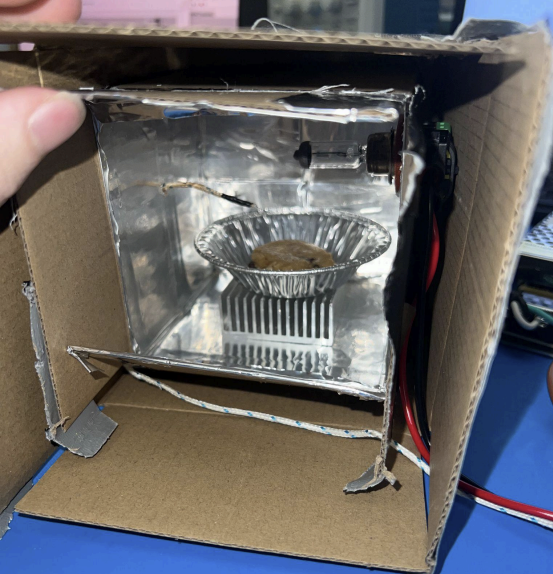
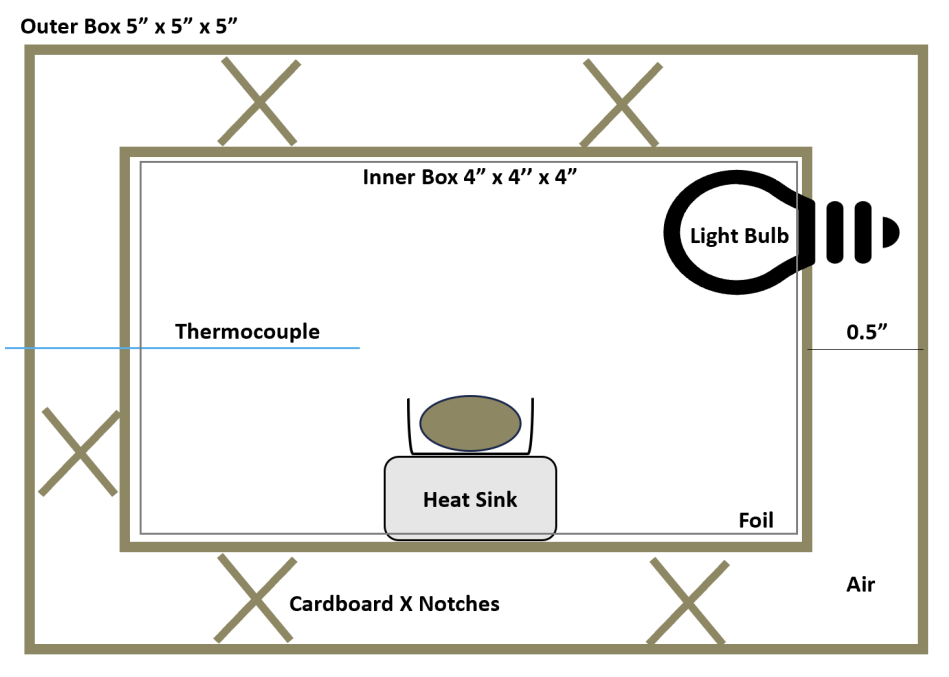
I designed and built a cardboard “easy-bake” oven that could reach and hold 350 °F while staying under a 55 W, 12 V halogen-bulb limit by combining heat-transfer modeling with closed-loop control. I started by modeling the oven walls as a multi-layer thermal resistance and predicting a steady-state heat loss of ~44.5 W, which translated to a target duty cycle of ~81%; I then built a nested-box prototype (4" inner cavity inside a 5" outer shell with a 0.5" air gap and foil lining) and instrumented it with a K-type thermocouple. To safely drive the heater from a low-power control signal, I used an NI PCIe-6321 DAQ to output 0–5 V PWM and integrated an N-channel MOSFET module to switch the 12 V load. In LabVIEW, I implemented and tuned a PID controller (Kp = 7.5, Ki = 0.8) to reduce overshoot and hold temperature, then validated performance by comparing the predicted duty cycle to the measured steady-state value (~79%) and documenting the full system (wiring, circuit/flow diagrams, and results). Throughout the build, I relied on hard skills in thermal analysis, DAQ/LabVIEW programming, and circuit integration, and soft skills like iterative troubleshooting, technical communication, and disciplined testing.

Nichrome Scale

Junior Year - MEGN 300

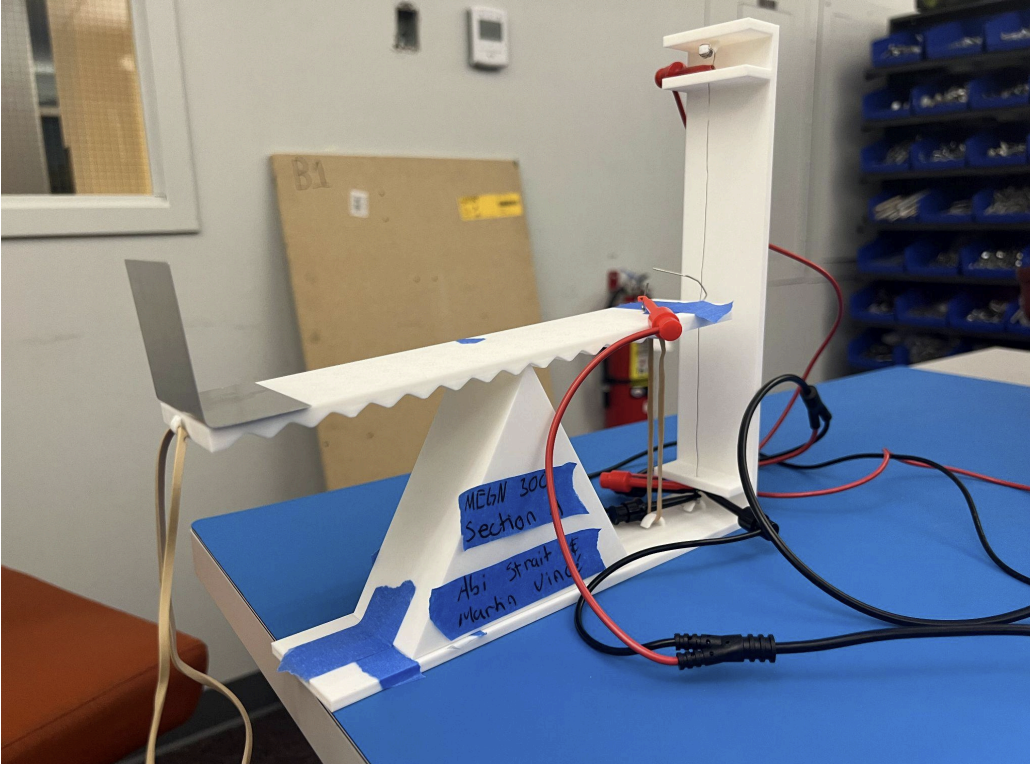
I engineered a compact digital scale that converted a small applied weight (0-150g) into a clean voltage signal and an automated mass readout. I used a lever-and-“spring” (rubber band) mechanism to amplify displacement, then built a custom nichrome-wire potentiometer where a wiper slid along the wire as the lever deflected, changing the measured voltage; I captured those signals with an NI-DAQ and processed them in LabVIEW with a calibration SubVI and a one-tap tare feature (so the scale could be zeroed instantly before each measurement). I then ran a structured calibration using known masses to fit an empirical transfer function and validated performance with repeat trials, uncertainty analysis, and a 95% confidence resolution, while also troubleshooting real-world non-idealities like contact resistance, geometry shift, placement sensitivity, and hysteresis. Along the way I strengthened hands-on prototyping and instrumentation skills (DAQ setup, signal acquisition, LabVIEW automation) plus engineering communication and teamwork through full documentation (diagrams, drawings, operating procedure, and demo materials). Click the button above to read the full final report of my scale project!

Image of Econ Discrete Solution Image of Econ Revenue Distributions Image of Econ SIPmath

Economic Analysis of Asset

Junior Year - EBGN 321

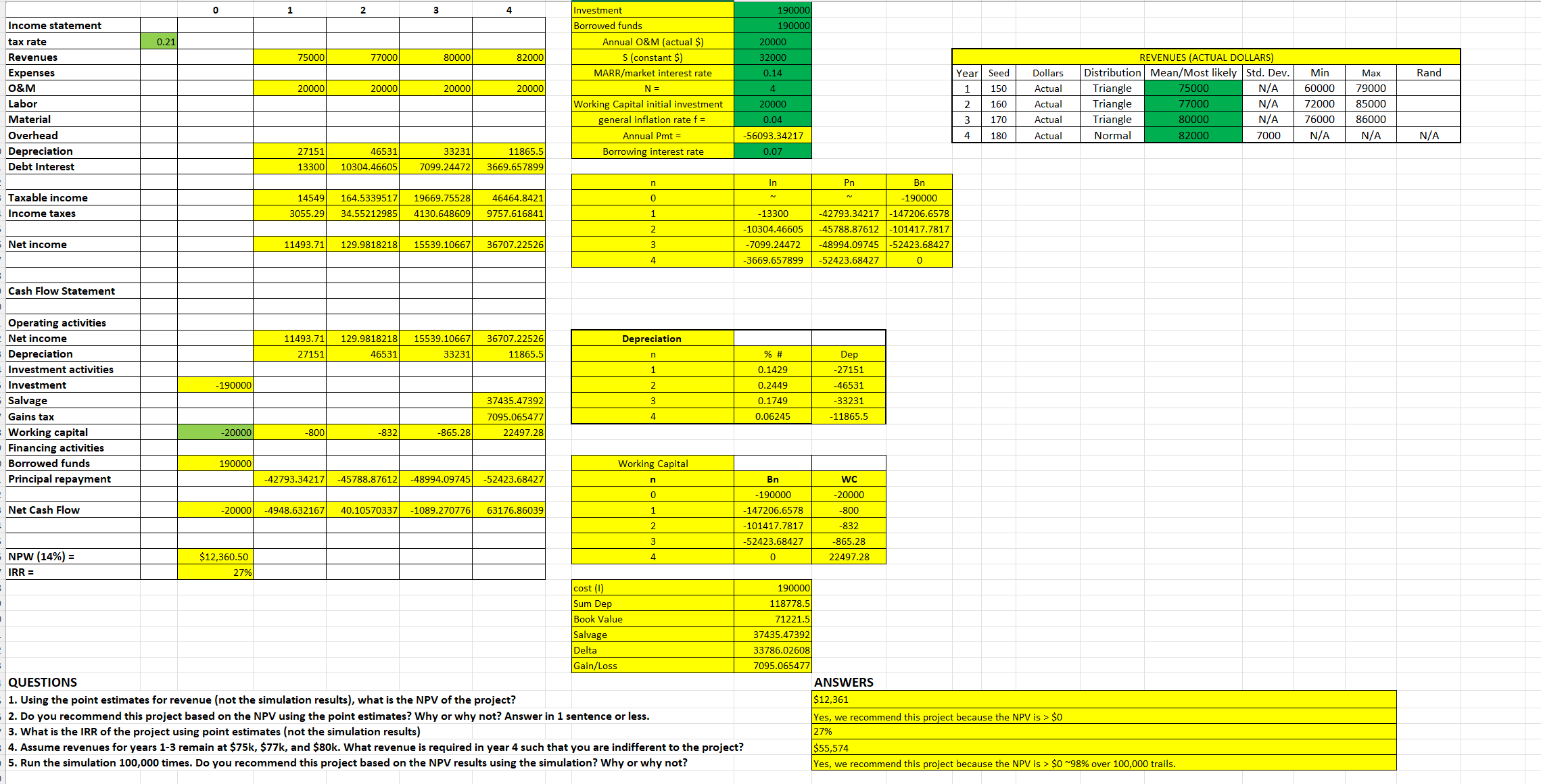
For my Engineering Economics (EBGN 321) project, I built an Excel decision model to determine whether a proposed asset purchase was worth accepting under real-world financial constraints. I modeled the full cash-flow lifecycle—including upfront cost, working capital, depreciation/taxes, operating impacts, and bank-loan financing—then evaluated feasibility using Net Present Value (NPV). To account for uncertainty in future revenue, I used SIPmath to run multiple randomized trials of predicted revenues (Monte Carlo-style), calculated an NPV for each trial, and then used COUNTIF() to measure the percentage of scenarios where NPV met or exceeded the acceptance threshold. This let me make a decision based not just on one “expected” case, but on the project’s likelihood of success, using a mix of financial modeling, spreadsheet engineering, and careful organization/communication so the logic was easy to audit.

K-Means Clustering ML Model

MIT IDSS ML & DS: Data Driven Decisions Certificate Course

In my Customer Personality Segmentation ML project, I used Python in a Jupyter/Google Colab-style notebook to turn raw marketing/customer data into actionable customer segments. I started with univariate analysis (histograms/boxplots) to understand distributions, flag outliers, and decide what needed cleaning/engineering before clustering. From there, I built and evaluated a K-Means clustering approach in scikit-learn, using matplotlib to generate an elbow plot (suggesting ~4 clusters) and a silhouette score sweep, then chose k = 2 for clearer separation/interpretability and confirmed it visually using a PCA cluster plot. Finally, I translated the clusters into business-facing insights—like budget-conscious families vs. high-spend/premium behaviors—and wrote targeted recommendations for marketing/retention and operational improvements (loyalty/VIP programs, channel-specific campaigns, and web UX/checkout optimization).

Random Forest ML Model

MIT IDSS ML & DS: Data Driven Decisions Certificate Course

For this project, I built and evaluated Decision Tree and Random Forest classification models to predict whether a sales lead will convert to a paid customer, and I treated it like a real business problem where the cost of mistakes matters. I started by splitting the dataset into train/test sets for repeatable evaluation, then I defined the “bad outcomes” (false negatives vs. false positives) and decided to prioritize recall because missing a lead that would convert is a bigger loss than spending effort on a lead that doesn’t. To measure performance clearly, I used standard classification tooling (classification report + confusion matrix) and iterated on tree depth / complexity to balance precision, recall, and F1 instead of blindly maximizing accuracy. After that baseline, I trained a Random Forest model and used feature importances to interpret what was driving predictions, including plotting the top contributors for an explainable summary. Overall, this project strengthened my hard skills in Python + scikit-learn modeling workflows, metrics-driven evaluation, and model interpretability, plus the soft-skill side of translating a business objective (minimize missed conversions) into a concrete ML target and evaluation strategy.

Image of Engineering Drawing Image of Batmobile Derby Car

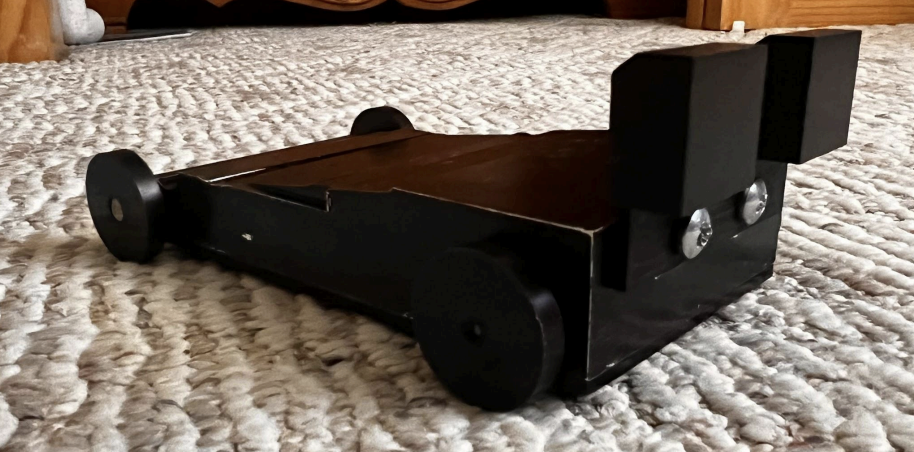
Batmobile Derby Car

Sophomore Year - MEGN 201

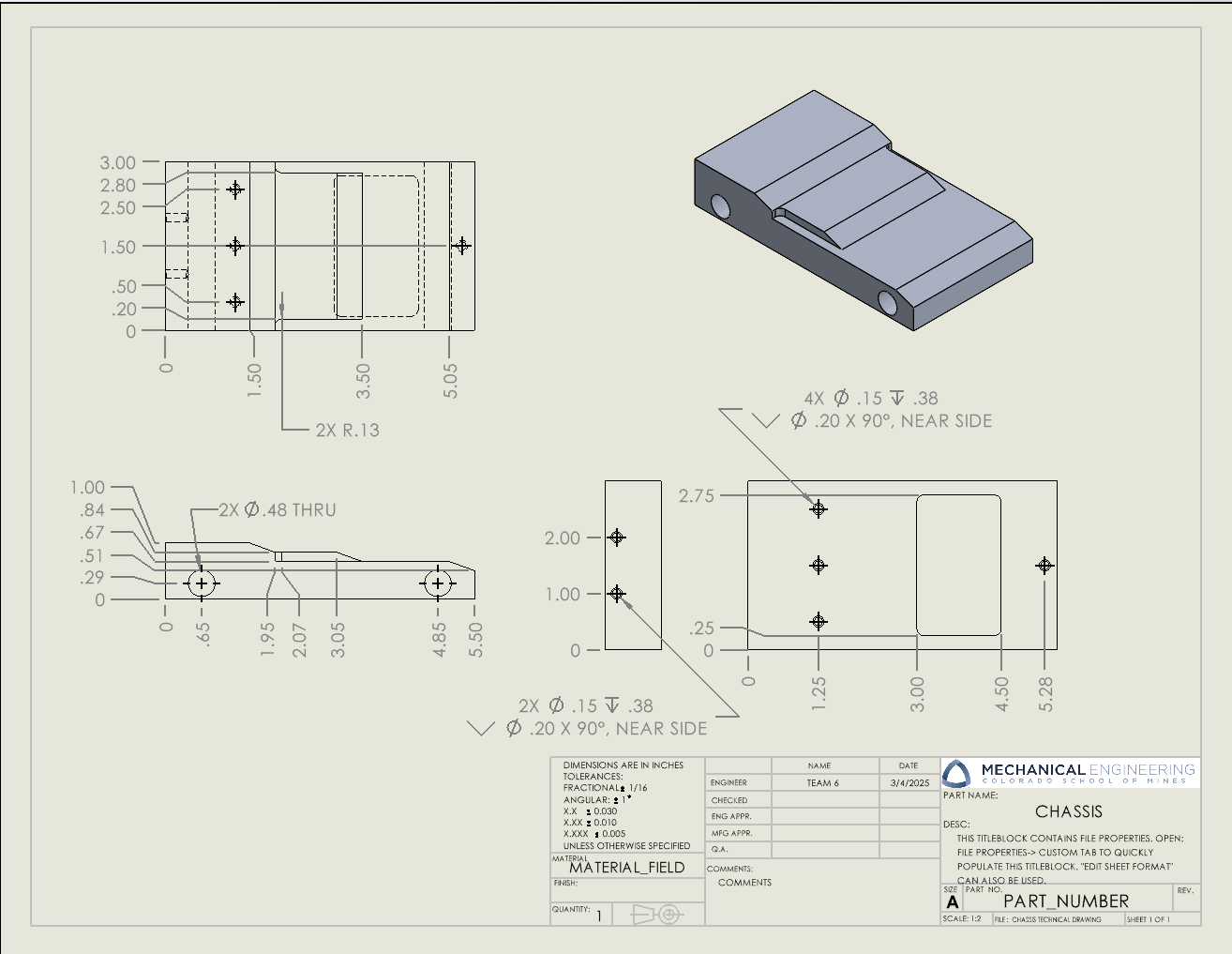
For my Batmobile Derby Car project, my goal was to take a concept-style Batmobile design and turn it into a track-ready derby car that was both fast and manufacturable. I modeled the full assembly in SolidWorks, using tight parametric control and GD&T-based drawings to drive an iterative design process where I also checked aerodynamics and mass distribution (including CFD-style analysis) to support speed and stability. From there, I translated the drawings into real parts by setting up and running manual mill/lathe operations (facing, turning, drilling, tapping), holding tight tolerances (down to about ±0.005 in on axle bores and wheel hubs) and verifying fits using calipers/micrometers. I also programmed toolpaths in Inventor CAM for CNC milling/lathe work to fabricate custom components from aluminum and ABS, then worked with my team through assembly, troubleshooting, and final tuning—building both hard skills (CAD/CAM, machining, metrology) and soft skills (team coordination, clear technical communication, and iterative problem-solving under time constraints).

Thermodynamic Optimization of the Mine's Steam Plant

Sophomore Year - MEGN 261

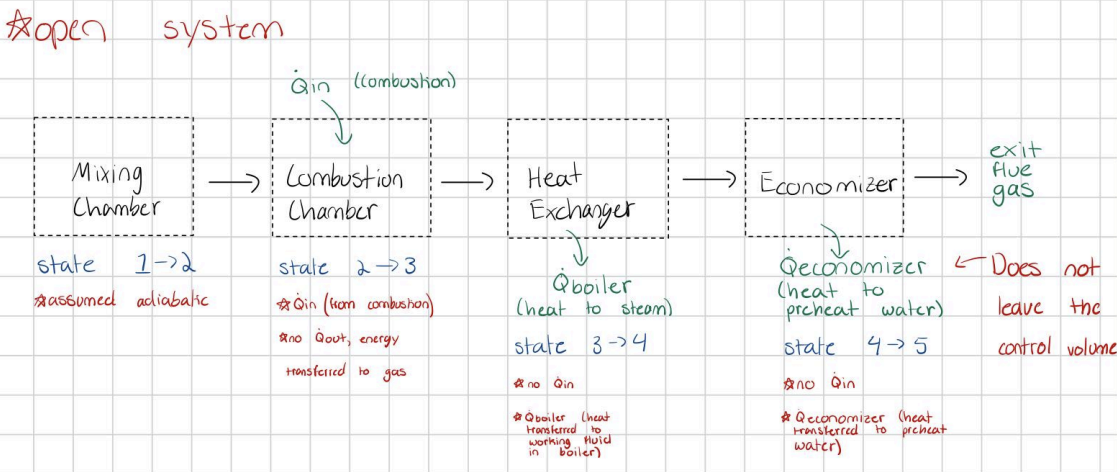
In our Boiler Busters steam plant optimization project, I analyzed the Colorado School of Mines steam plant as a real-world Rankine-cycle system and focused on how retrofits could meaningfully improve efficiency in existing infrastructure. I built and evaluated a thermodynamic model by defining control volumes, deriving the steady-state mass/energy/entropy balances, and then implementing the full system in Engineering Equation Solver (EES) to run a parametric study on key operating variables (including outside air temperature, flue gas recirculation, economizer effectiveness, steam pressure, and boiler losses). Using the simulation results, I interpreted the trends and tradeoffs, and identified the strongest improvement pathway: combining higher flue gas recirculation with reduced boiler losses, which raised the simulated efficiency from roughly 83% to 95%—showing how compounding changes can outperform single-variable tweaks. Along the way I practiced core hard skills (thermo modeling, property lookups, parametric simulation, and results communication) plus teamwork and technical writing by turning our analysis into a clear set of recommendations and a polished report.

Automated Trashcan

Sophomore Year - MEGN 200

I designed and prototyped an automated trashcan to improve accessibility and hygiene by automating tasks like detecting user presence, opening/actuating mechanisms, and assisting with trash bag removal/replacement. I programmed dual Arduino-based control systems in C++ and integrated multiple sensors (VOC sensing for odor/air-quality feedback and ultrasonic sensing for proximity/level detection) with actuators including stepper motors, servo motors, and an electromagnet-driven mechanism. I developed the mechanical system in parallel using 3D-printed parts—designing gears, mounts, linkages, and a linear-actuator-style motion path—then iterated on tolerances and assembly to get reliable motion and alignment. I also built and tested a spray/cleaning mechanism using custom hardware and printed components, and I validated performance through repeated prototyping cycles, wiring/debugging, and code refactoring as issues like sensor noise, timing conflicts, and mechanical binding showed up. This project strengthened my hard skills in embedded systems (Arduino/C++), sensor integration, mechatronics, electromechanical design, rapid prototyping/3D printing, and troubleshooting, while also building soft skills in project planning, documenting design decisions, communicating technical tradeoffs, and persistence through multi-week iteration toward a patent-oriented deliverable.

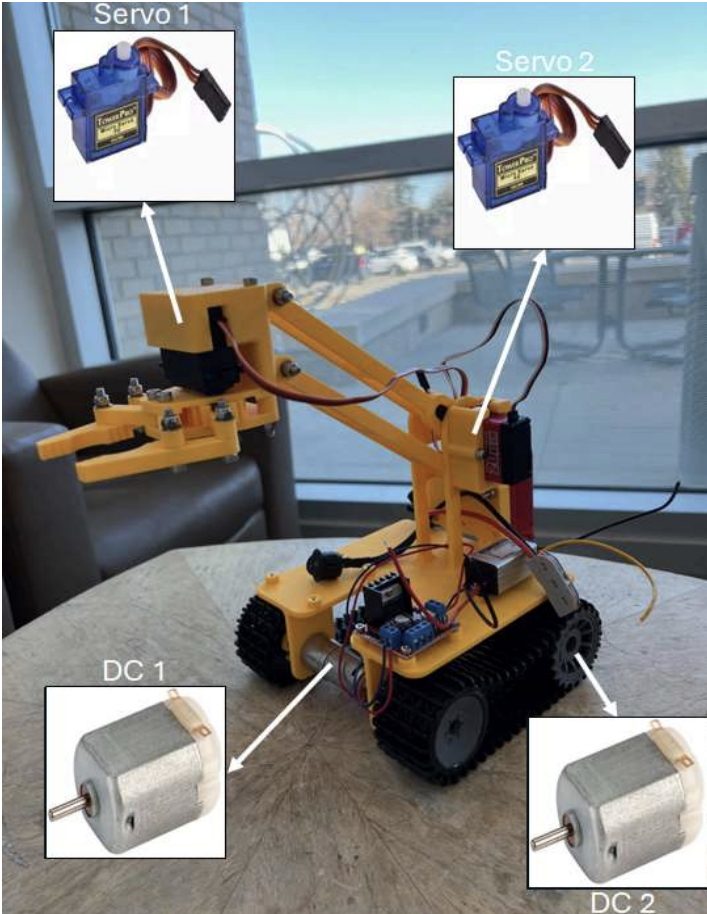
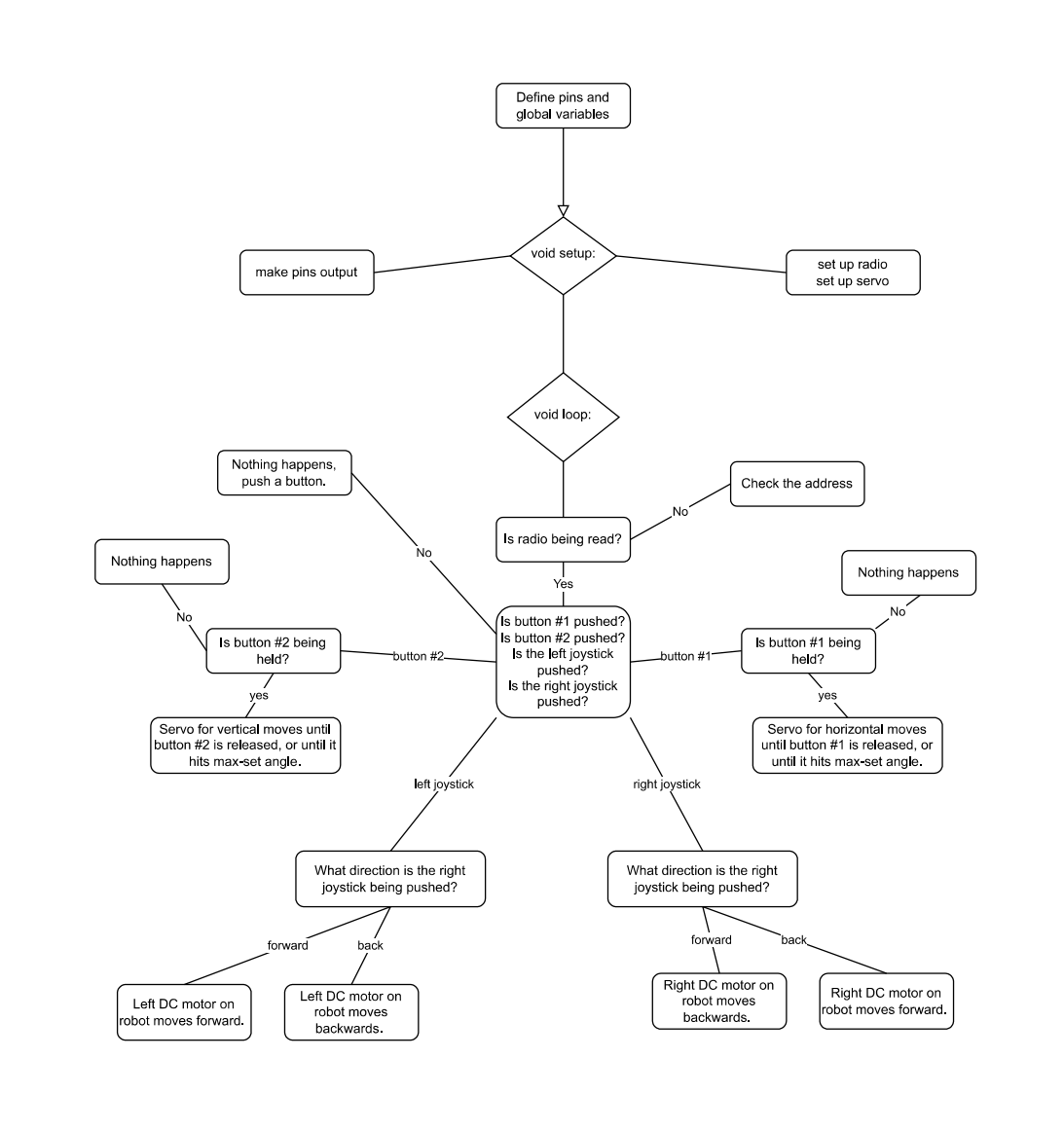
Image of CoLE Robot and it's motors Image of flowchart describing how the CoLE Robot code works

CoLE Robot

Sophomore Year - MEGN 200

I built a two-part, wireless-controlled robot system by programming and wiring two separate Arduino-based microcontroller setups—one as a handheld controller and the other as the robot—so that user inputs could be transmitted and converted into physical motion. I programmed both microcontrollers in Arduino C, implementing the transmitter logic and status indicators on the controller side, and the receiver logic plus actuator control on the robot side using components like H-bridges, a servo motor, and a stepper motor. I designed and 3D printed a handheld “Xbox-style” controller enclosure on a Bambu Lab printer to securely house the Arduino, breadboard, wiring, and transmitter hardware, then assembled and fit-checked the electronics to keep everything compact and durable. I wired both systems cleanly and repeatably, created wiring diagrams to document the build, and debugged issues across both hardware and software (signal reliability, power distribution, and motor control timing). This project strengthened my hard skills in embedded programming, wireless communication integration, circuit wiring, and electromechanical control, and it built soft skills in documentation, iterative troubleshooting, and designing for usability and maintainability.

PVRV Emissions Sensor

Freshman Year - EDNS 444

In my freshman-year graduate data course, I worked on the Innov8X PVRV Emissions Sensor project to address methane/emissions release risks tied to pressure/vacuum relief valves (PVRVs) by developing a concept for sensing/estimating valve behavior and emissions more reliably than existing approaches. I drove the early problem framing by leading stakeholder conversations with Williams and other natural-gas industry contacts, turning their constraints and pain points into a clearer problem statement and design requirements. From there, I translated ideas into tangible solution concepts by creating SolidWorks CAD models for improved pretotypes, and I supported the technical direction with data/engineering work using Python for analysis alongside Arduino C for embedded/prototyping logic. Across the project, I relied heavily on project management and communication to keep work moving (running meetings, tracking tasks, and presenting progress), while also strengthening hard skills in CAD, scripting/data analysis, and microcontroller-based prototyping using common engineering tools like Excel and Word for documentation and deliverables.

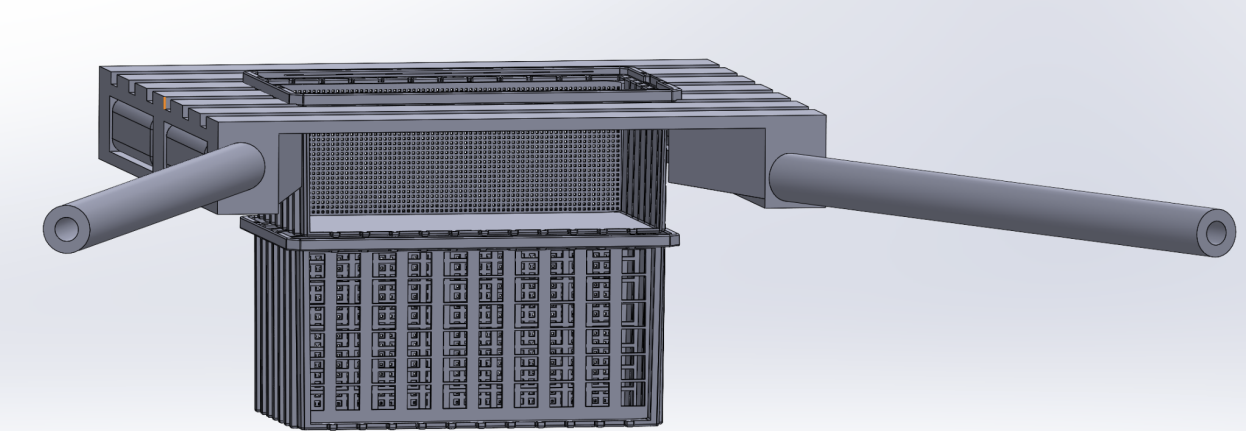
River Interceptor

Freshman Year - EDNS 151

In my Freshman Design “River Interceptor” project, I tackled the problem of reducing aquatic debris in landlocked bodies of water by designing a low-cost, upcycled collection system that could capture both floating macro-waste and underwater micro-waste. I translated the problem into clear design requirements (durable, waterproof, maintainable, cost-effective, and river-focused), then used concept generation and decision matrices to converge on a final “RIC” architecture: an upcycled wooden pallet bridge supporting an above-water tote with mesh screening for macro-waste, and an underwater filtration section built from window screening wrapped around PVC to trap smaller particles, stabilized with flotation jugs and a pool-noodle straddle/funnel system anchored to shore with paracord/tent stakes. I modeled key components in SolidWorks and planned validation through field testing at Clear Creek, where I confirmed surface trash capture during trials and iterated when the lower collection assembly failed due to attachment integrity (rebuilding with improved adhesive placement and stronger connections). I also incorporated basic instrumentation by integrating an ultrasonic sensor with an ESP32 and cloud notification (Blynk) to signal when the bin reached a fill threshold, while keeping the prototype under budget (about $71) through material upcycling and lean BOM decisions.